Showing posts with label Division Practice. Show all posts

Sunday, May 30, 2010

Double Division with 3 Digit Divisors 612416/983


Method of Vietnamese Diagram: Double the Divisor 3 Times
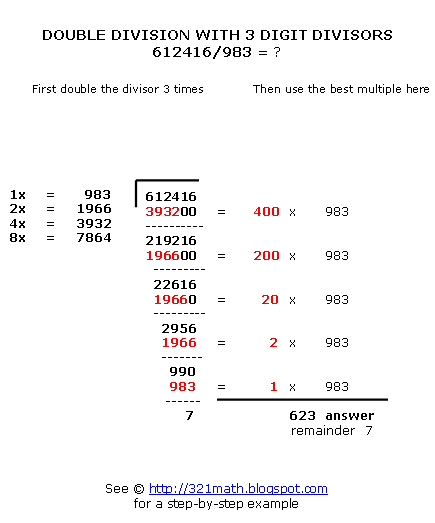

Method of International Diagram: Double the Divisor 3 Times

Method of Vietnamese Diagram:  Double the Divisor 5 Times
It's Easy!
Step 1 - Double, double, double.
Step 2 - Subtract off multiples.
Step 3 - Add up your answer."

Photos source: Nguyen Thi Lan Phuong, http://321math.blogspot.com

Friday, May 21, 2010

How to make Long Division with Remainders?

When we are given a long division to do it will not always work out to a whole number.
Sometimes there will be numbers left over. These are known as remainders.

e.g: 435 ÷ 25 

4 ÷ 25 = 0 remainder 4 The first number of the dividend is divided by the divisor.

The whole number result is placed at the top. Any remainders are ignored at this point.
25 × 0 = 0 The answer from the first operation is multiplied by the divisor. The result is placed under the number divided into.
4 – 0 = 4 Now we take away the bottom number from the top number.

Bring down the next number of the dividend.
43 ÷ 25 = 1 remainder 18 Divide this number by the divisor.

The whole number result is placed at the top. Any remainders are ignored at this point.
25 × 1 = 25 The answer from the above operation is multiplied by the divisor. The result is placed under the last number divided into.
43 – 25 = 18 Now we take away the bottom number from the top number.

Bring down the next number of the dividend.
185 ÷ 25 = 7 remainder 10 Divide this number by the divisor.

The whole number result is placed at the top. Any remainders are ignored at this point.
25 × 7 = 175 The answer from the above operation is multiplied by the divisor. The result is placed under the number divided into.
185 – 175 = 10 Now we take away the bottom number from the top number.


There is still 10 left over but no more numbers to bring down.

With a long division with remainders the answer is expressed as 17 remainder 10
as shown in the diagram

Teaching Long Division and Double Division

"Teaching Double Division can help in teaching long division by reinforcing the principles of division and giving students success with a less frustrating alternative.
 
Double Division does not depend on memorizing the multiplication facts or estimating how many times one number goes into another. It may take 50% longer, but it is far less frustrating and probably easier to understand than Long Division.
 
It's Easy!
Step 1 - Double, double, double.
Step 2 - Subtract off multiples.
Step 3 - Add up your answer."

References:
  • http://www.doubledivision.org
  •  http://en.wikipedia.org/wiki/Long_division